



Hydrocodone vs. Oxycodone: What’s the Difference?
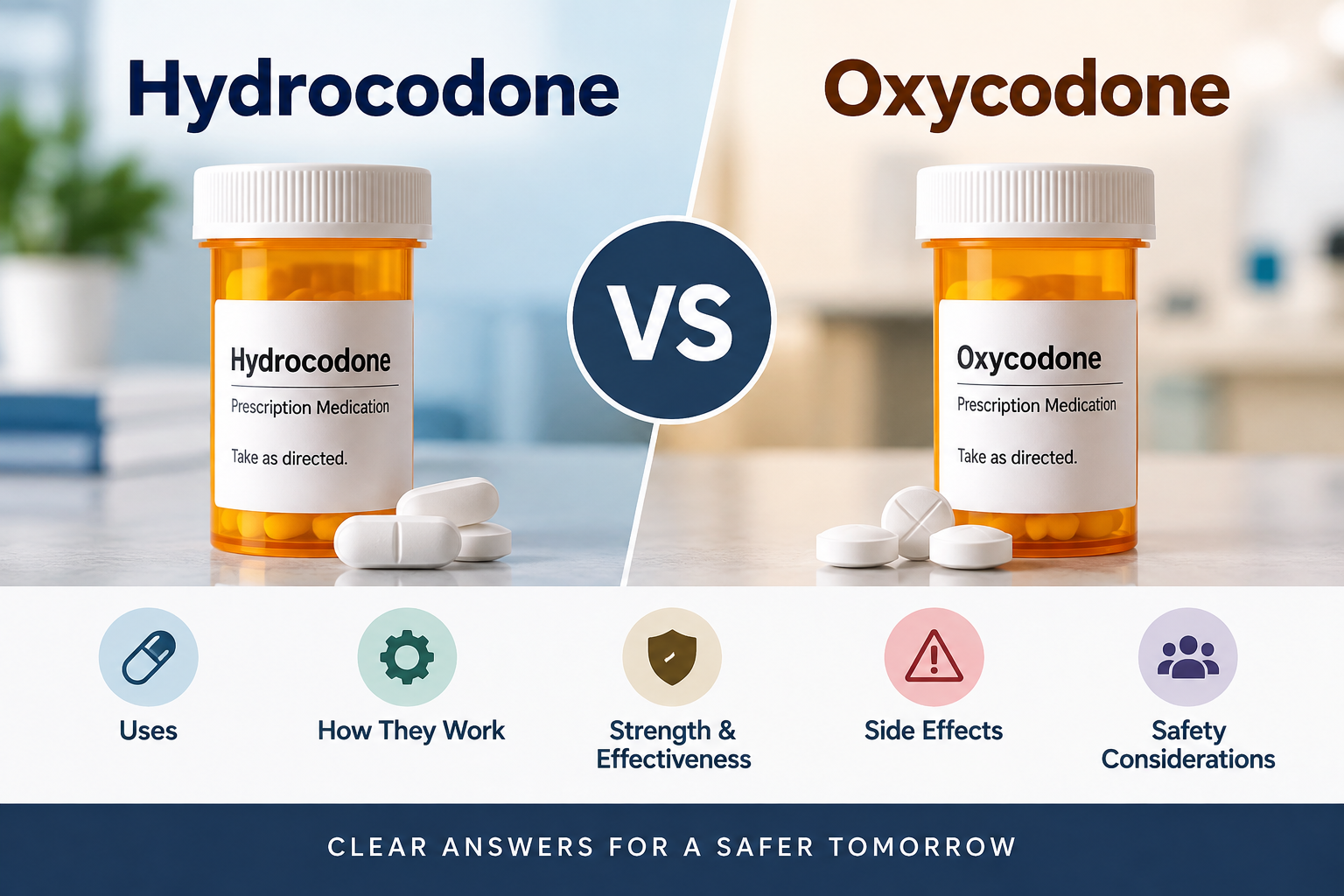
Choosing between hydrocodone and oxycodone is rarely about a simple better-or-stronger label. Both are opioid pain medicines, and both share important benefits, risks, and prescribing limits. CDC guidance notes evidence for opioids mainly supports short-term pain relief, which frames this comparison.
The key differences usually turn on dose, formulation, timing, and clinical use. That distinction matters for pain control, side effects, dependence, and regulation. From there, each area needs a closer, more practical look before treatment decisions.
Buy Hydrocodone Online
Buy Oxycodone Online 80 mg
Defining Hydrocodone and Oxycodone: Core Characteristics
Hydrocodone and oxycodone are best understood first as opioid pain medicines, not interchangeable labels. Each sits in the same broad drug class, which helps explain why they are often discussed together.
What matters at this stage is the category: both are prescribed for pain, and both carry the core benefits and risks linked to opioids. CDC guidance in Morbidity and Mortality Weekly Report says opioid evidence supports short-term pain relief and some functional improvement, mainly in trials lasting 12 weeks or less.
That matters because the shared opioid profile is clearer than any simple one-drug-versus-the-other shortcut. It also sets a limit. The CDC notes that opioid recommendations vary, including dosing thresholds from 90 to 200 MME per day, so careful comparison depends on dose, formulation, and clinical use.
How These Opioids Work in the Body
Because both drugs fall under the opioid label, the first body-level takeaway is shared action, not a completely separate category.
- Oregon.gov lists hydrocodone and oxycodone among medically used opioids. That means the body meets them through the same broad drug class before dose, product design, or prescribing context shape the experience further.
- That shared class matters for interpretation. If two medicines sit in the same opioid group, a simple works one way versus the other shortcut usually misses the bigger point.
- There is also a boundary here. The Oregon.gov page mainly clarifies drug grouping and language, not a detailed receptor-by-receptor comparison, so body effects still need to be weighed alongside formulation and clinical use.
- For readers, the practical implication is clear: compare these medicines as related opioids first, then look at the specific product details that can change how strongly or how long each one acts.
Medical Uses: Similarities and Distinctions
Clinically, the overlap is larger than the split. Both medicines are used in pain treatment. The real question is usually more specific. It is how a prescriber matches a product, strength, and schedule to the clinical situation.
That is where differences start to matter. In practice, medical use depends on the type of pain. It also depends on how long relief needs to last. Treatment goals matter too, especially when care is brief versus ongoing.
Those factors shape use more than a simple stronger-versus-weaker label. For readers comparing hydrocodone and oxycodone, the useful takeaway is to look at the intended pain setting, product form, and timing of relief, not just the drug name when weighing likely clinical fit.
Potential Side Effects and Safety Considerations
Safety questions around these opioids are less about a simple drug winner and more about how opioid treatment is managed over time.
- Starting treatment is one safety checkpoint. The CDC clinical practice guideline frames opioid decisions around whether starting an opioid makes sense at all.
- items 2???
- Dose is another checkpoint. The same CDC guideline treats opioid selection and dosage as safety issues, not just pain-control choices.
- Duration and follow-up matter too. The CDC notes that initial prescribing length and reassessment are part of addressing potential harms.
- Risk review has to stay broader than the pill itself. CDC says opioid recommendations weigh benefits, harms, patient and clinician values, and resources, so the safer comparison is the one tied to prescribing context.
Comparing Effectiveness for Pain Management
Effectiveness is not a simple across-the-board win for either drug. The clearest comparison here comes from postoperative joint replacement care, not every pain setting. In a cohort study summarized by Scholars@Duke, hydrocodone and oxycodone were used after elective joint arthroplasty within a multimodal pain plan that also included nonopioid treatment.
Among 663 CYP2D6 normal metabolizers treated at 5 US surgery sites from 2021 to 2023, hydrocodone was linked to slightly lower composite pain scores by day 10 and lower cumulative morphine milligram equivalents over 10 days.
That suggests similar pain relief with less total opioid exposure in that specific setting. Still, the boundary matters. The study focused on normal metabolizers after surgery, so it does not settle which drug works better for every patient or every kind of pain.
For readers, effectiveness depends on the clinical context as much as the drug name.
Dependency Risks and Withdrawal Differences
Dependence risk matters here because both medicines can create physical reliance over time.
- Physical dependence is not the same as addiction. The body adapts, so sudden stopping can bring withdrawal.
- That shared opioid effect makes a simple safer-versus-riskier ranking hard to support. Dose, duration, and patient history often matter more.
- Withdrawal can overlap for both drugs, including restlessness, body aches, and stomach upset. Severity often tracks exposure and treatment length.
- Longer use usually raises more concern than brief, closely managed treatment. Still, no fixed timeline predicts exactly who will struggle.
- The practical takeaway is careful tapering rather than abrupt discontinuation. For readers, context around prescribing remains more useful than the drug name alone.
Legal Status, Regulations, and Prescription Trends
Regulation shapes the comparison as much as chemistry does. Both drugs sit inside the same controlled opioid framework, so prescribing trends reflect broader policy pressures, not just one label. A Congress.gov report says opioid use patterns in the United States are influenced by clinical guidance, prescribing rules, monitoring programs, payment systems, and access to other pain treatments.
That matters when readers see rising or falling prescription counts. Raw counts can miss prescription length, pill number, and potency. The same report notes several tracking methods, including total prescriptions and morphine milligram equivalents, or MMEs.
Even MMEs have limits, since conversion tables can vary by source. So legal status and trend data help with context, but they do not prove one drug is categorically preferred, safer, or more tightly regulated in everyday practice.
Rather, hydrocodone and oxycodone differ in use more than in basic category. Both are opioid pain medicines, so neither stands out as a universal best choice. The clearest distinction comes from dose, formulation, timing, and the clinical setting.
One postoperative study linked hydrocodone to similar relief with less opioid exposure, but only in normal metabolizers after joint surgery. CDC guidance also frames opioid decisions around short-term benefit and careful risk review.
In practice, the safer comparison asks which product fits the patient and prescribing context most closely.